
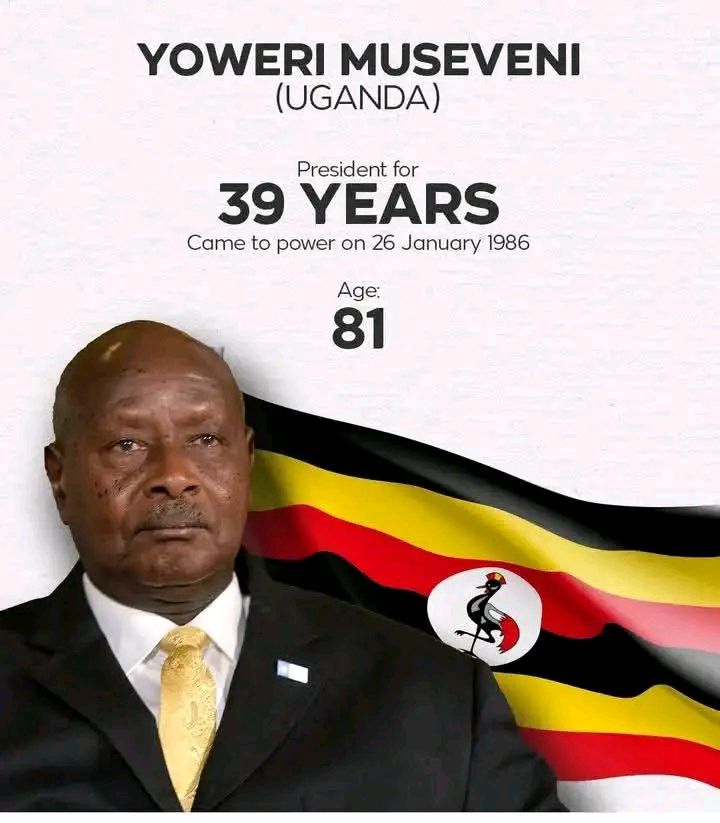
Kampala, Uganda – In a major political development, Uganda’s long-serving President Yoweri Museveni, 80, has officially announced his candidacy for a seventh term in the 2026 general elections, extending a presidency that began in 1986 and raising new concerns about the state of democracy in the East African nation.
Museveni’s campaign was formally launched on June 28, 2025, when he collected his nomination forms, setting the stage for what is expected to be a fiercely contested and deeply polarized election.
Speaking to supporters, Museveni pledged to elevate Uganda’s GDP from $66 billion to $500 billion within five years — an ambitious economic promise that includes a boost in infrastructure, agriculture, and digital transformation. He also vowed to lead a “final phase of Uganda’s liberation”, which he described as an all-out war on corruption, claiming a renewed commitment to good governance.
The president’s announcement has sparked a sharp response from opposition leader Robert Kyagulanyi Ssentamu, popularly known as Bobi Wine, who has confirmed his candidacy. Kyagulanyi has described Museveni’s continued rule as a betrayal of Uganda’s democratic ideals, stating, “This regime is not interested in free and fair elections. What Uganda needs is a generational shift in leadership, not a recycled presidency.”
Museveni’s government remains a family affair, with his son, Gen. Muhoozi Kainerugaba, serving as Chief of Defence Forces, and his wife, Janet Museveni, as Minister of Education. Critics argue this concentration of power within the president’s inner circle has eroded institutional independence.
Analysts and human rights advocates have raised significant concerns, particularly around:
The abolition of presidential term and age limits, which has been viewed as clearing the way for lifetime rule.
Alleged weakening of judicial and parliamentary independence, with claims of political manipulation.
Continued trial of civilians in military courts, a practice ruled unconstitutional by Uganda’s Supreme Court in 2024 but reportedly still ongoing.
The 2026 election will be a critical moment for Uganda’s democracy. For some, Museveni remains a stabilizing force; for others, he embodies a deepening authoritarianism. As campaigns ramp up, eyes across the region and the world will be watching to see whether Uganda moves toward reform or further consolidates one-man rule.
—END—
 Image TV
Leave a comment